Introduction: Packaging Is a Structural Decision, Not a Logistics Detail
In international trade, buyers often spend weeks finalizing product specifications and minutes approving packaging. That imbalance is costly.
For tiles and natural stone, packaging is not a secondary activity. It is a structural protection system that determines whether your cargo arrives intact or arrives as an insurance claim.
Whether you are importing porcelain tiles, large-format slabs, ceramic wall tiles, granite, or marble, the choice between wooden pallets and pine wood crates directly impacts breakage rates, handling safety, container optimization, and claim outcomes under FOB or CIF terms.
Why Packaging Standards Matter More in Tiles and Natural Stone
Tiles and stone are heavy, brittle, and vibration-sensitive. During sea transit, containers experience stacking pressure, lateral movement, humidity changes, and repeated handling.
When breakage occurs, it is rarely because the product was weak. It is because the packaging failed to absorb stress.
From a buyer's standpoint, poor packaging creates three problems simultaneously: physical damage, documentation disputes, and strained supplier relationships. This is why packaging standards must be defined as clearly as product specifications.
Wooden Pallets: The Industry Default for Volume Shipments
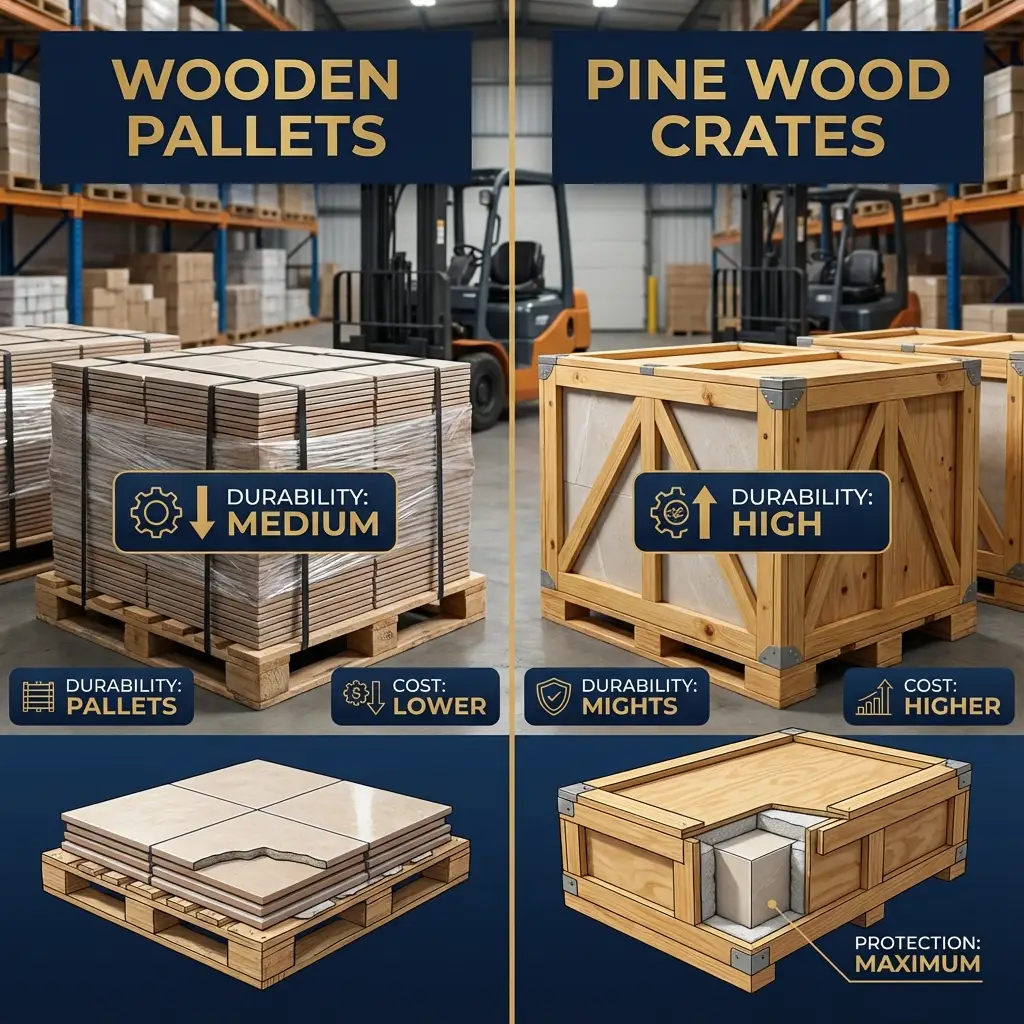
Wooden pallets are the most common packaging method used in tile exports, especially for ceramic wall tiles and standard porcelain tiles.
Pallet-based packing involves stacking cartons on a wooden base, securing them with plastic or steel strapping, corner protectors, and shrink wrap. When executed correctly, this method allows efficient handling by forklifts and faster container loading.
From a logistics standpoint, pallets are attractive because they optimize container space, reduce packing cost, and speed up warehouse movement at both origin and destination.
However, pallets rely heavily on proper strapping, carton strength, and load distribution. If any of these elements are weak, the pallet becomes unstable under sea conditions.
Performance of Wooden Pallets in Export Conditions
In controlled conditions, pallet packing performs adequately for small to medium tile sizes, particularly wall tiles and standard floor tiles.
Problems arise when pallets are overloaded, cartons are poorly designed, or pallets are reused beyond their structural life. Under such conditions, tiles may shift, cartons may collapse, and edge breakage becomes common.
Pallet packing also offers limited lateral protection. During long voyages or rough handling, horizontal movement inside the container can transmit stress directly to the tiles.
For price-sensitive markets, pallets remain popular. For risk-sensitive projects, pallets must be engineered carefully, not treated as generic.
Pine Wood Crates: Structural Protection for High-Risk Cargo
Pine wood crates are a structural packaging solution, not just a base for stacking.
Crate packing involves enclosing tiles or slabs within a rigid wooden framework, often with internal cushioning, separators, and bracing. This system distributes load across the crate rather than the product itself.
Crates are commonly used for large-format porcelain slabs, granite slabs, marble slabs, and high-value stone products where breakage risk is unacceptable.
From a supply-chain perspective, pine wood crates are not about speed or cost efficiency. They are about damage prevention and claim avoidance.
Performance of Pine Wood Crates in Sea Transit
Crates perform significantly better than pallets under vibration, stacking pressure, and uneven handling. The rigid structure prevents load transfer directly onto tile edges or stone surfaces.
For large-format slabs, crate packing reduces flex stress and minimizes micro-cracks that may not be visible at origin but become failures during fabrication or installation.
Crates also offer better moisture control when combined with plastic lining or desiccants, which is critical for long transit routes.
The trade-off is weight, cost, and handling complexity. Crates occupy more space and reduce the total quantity that can be loaded per container.
Wooden Pallets vs Pine Wood Crates: Commercial Comparison
From a B2B buyer's perspective, the choice is not binary. It is situational.
Wooden pallets prioritize cost efficiency, volume, and speed. Pine wood crates prioritize structural safety and risk reduction.
If the product value is moderate and replacement is feasible, pallets may be acceptable. If the product is large-format, high-value, or project-critical, crates are often the safer commercial decision.
The mistake buyers make is choosing pallets for products that clearly demand crating, purely to save on packaging cost. That saving disappears with the first broken container.
Impact on FOB and CIF Responsibilities
Under FOB terms, packaging quality directly affects when risk transfers from seller to buyer. If goods are damaged after loading due to poor packing, disputes become complex and expensive.
Under CIF terms, buyers often assume packaging is the supplier's problem. That assumption is dangerous. Insurance may cover declared value, but it does not cover project delays, reputation damage, or reordering time.
Regardless of Incoterms, packaging failures always hurt the buyer more than the supplier.
Packaging Choice by Product Category
For ceramic wall tiles and small-format porcelain tiles, reinforced pallet packing is generally sufficient when cartons are strong and strapping is correct.
For large-format porcelain tiles and slabs, mixed solutions are often used, such as palletized A-frames or partial crating, depending on size and thickness.
For granite and marble slabs, pine wood crates or A-frame crates are the industry standard for a reason. These materials do not forgive packaging shortcuts.
Choosing the wrong packaging method for the product category is not a logistics error. It is a procurement error.
Common Buyer Mistakes in Export Packaging Decisions
Most packaging failures are predictable.
- Buyers often approve packaging based on photos instead of specifications
- Underestimate transit stress
- Accept "standard packing" without defining what standard means
- Not aligning packaging choice with destination handling conditions
A port with manual handling requires stronger packaging than one with automated systems. Finally, many buyers discover packaging problems only after arrival, when leverage is gone.
Why Packaging Should Be Defined in the Purchase Order
Serious buyers define packaging type, wood treatment requirements, pallet or crate dimensions, strapping method, and moisture protection directly in the purchase order.
This removes ambiguity, aligns inspection criteria, and prevents post-shipment arguments. Packaging is not an operational detail. It is a contractual specification.
Conclusion: Packaging Determines Whether Quality Reaches the Site
In international trade of tiles and natural stone, packaging is the last quality control step and the first failure point.
Wooden pallets and pine wood crates both have their place in the supply chain. The wrong choice increases breakage, delays, and disputes. The right choice protects margins and timelines.
At Aleron Ceramic, we treat packaging as a strategic part of export planning, not an afterthought. Whether shipping porcelain tiles, large-format slabs, ceramic wall tiles, or natural stone, we align packaging methods with product type, destination risk, and FOB or CIF responsibilities.