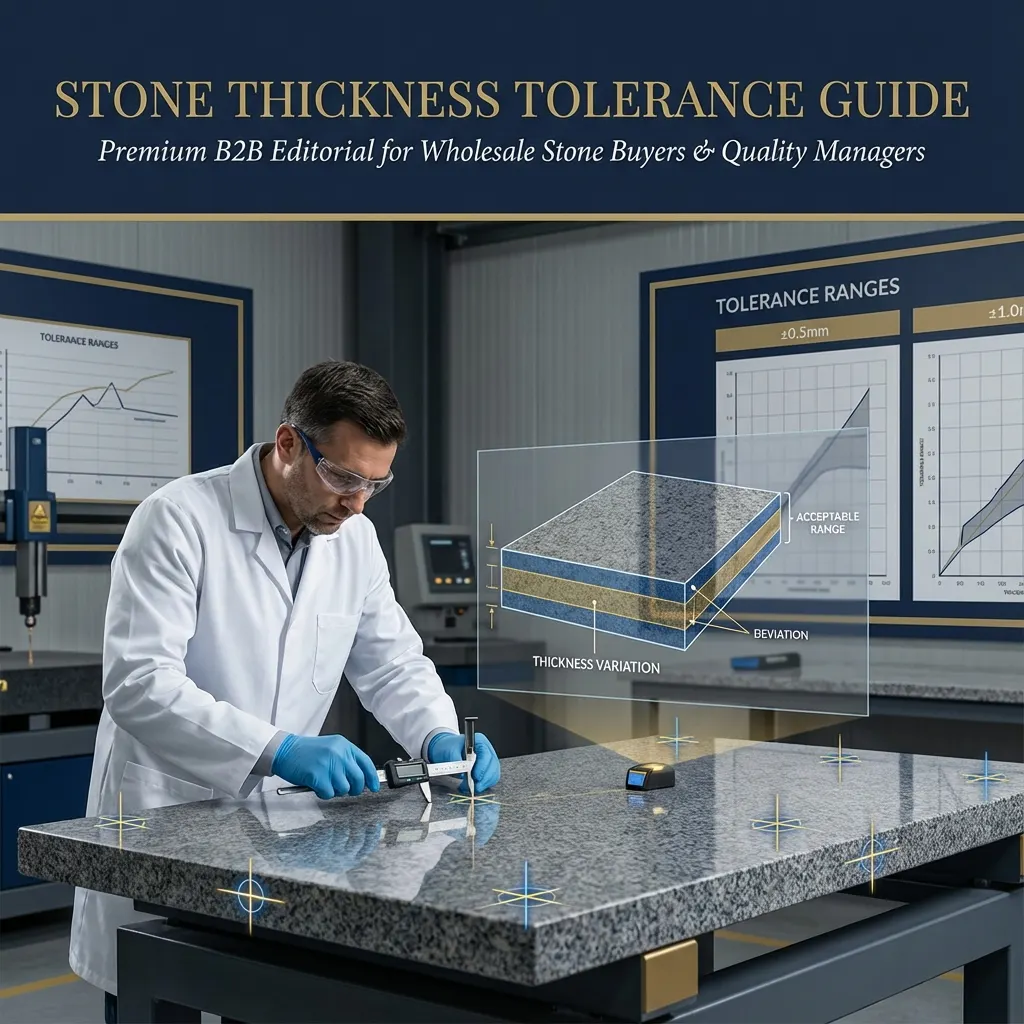
Introduction: Thickness Tolerance Is Where Most Stone Projects Go Wrong
In natural stone trade, buyers often focus on color, finish, and price, assuming thickness is a fixed parameter. It is not.
Unlike porcelain or ceramic tiles, natural stone is a geological material, not a factory-controlled composite. Thickness variation is inevitable. The real question is not whether variation exists, but how much variation is acceptable for export-quality stone.
For importers, wholesalers, and large-scale developers, misunderstanding thickness tolerance leads to uneven flooring levels, excessive adhesive consumption, fabrication rejections, installer disputes, and costly rework on site.
Why Thickness Tolerance Matters More Than Buyers Expect
Thickness variation affects more than appearance. In flooring applications, uneven thickness creates lippage and height differences. In cladding, it impacts anchoring systems. In countertops, it affects edge profiling and joint alignment.
From a supply-chain perspective, thickness tolerance also impacts polishing depth and surface finish consistency, breakage risk during handling, packing method and pallet stability, and replacement feasibility months or years later.
Thickness is not a detail. It is a structural parameter.
Natural Stone vs Engineered Materials: A Critical Distinction
Many buyers subconsciously apply ceramic tile logic to natural stone. That is a mistake.
Porcelain and ceramic tiles are pressed, fired, and calibrated in controlled environments. Natural stone slabs are cut from quarry blocks with inherent variation in density, grain, and internal stress.
Even with modern gangsaw or cutter technology, zero thickness deviation is unrealistic in natural stone. Export-quality does not mean perfect. It means controlled within industry-accepted limits.
Buyers who demand ceramic-level tolerance from natural stone often face delays, price escalations, or outright supplier refusal.
Industry-Accepted Thickness Tolerances in Export Stone
While exact tolerance depends on stone type, cutting method, and application, there are commercially accepted ranges in international trade.
For most export-quality granite and marble slabs, thickness variation of ±1.0 mm is considered acceptable. In well-controlled gangsaw operations, this may tighten to ±0.5 mm, but that is not universal.
For limestone and sandstone, which are softer and more porous, tolerance often extends slightly wider due to material behavior during cutting and polishing.
Problems arise when buyers assume a nominal thickness like "20 mm" means every slab will measure exactly 20.0 mm across its entire surface. That assumption is incorrect and dangerous.
Thickness Variation by Stone Type
Granite, due to its hardness and dense structure, generally allows better thickness consistency. Modern gangsaw-cut granite slabs often fall within tighter tolerance bands, especially when destined for commercial flooring or infrastructure projects.
Marble, being softer and more variable in composition, shows slightly higher thickness fluctuation. Resin filling, polishing depth, and vein density all influence final slab thickness.
Limestone and sandstone, which are sedimentary stones, are more sensitive to cutting pressure and polishing abrasion. Expecting ultra-tight tolerance from these stones without additional processing is unrealistic.
Understanding these differences allows buyers to match stone type with application, instead of blaming suppliers for geological reality.
Impact of Cutting Method on Thickness Tolerance
The cutting method used has a direct impact on thickness consistency.
Gangsaw cutting, which slices blocks using multiple parallel blades over extended cycles, generally produces more uniform thickness across slabs. This method is preferred for large commercial projects and export programs requiring consistency across containers.
Cutter or multi-blade machines operate faster and offer flexibility, but they typically produce wider thickness variation, especially when blocks are irregular or production is rushed.
Buyers rarely ask how slabs are cut. They should. Thickness tolerance begins at the cutting stage, not during inspection.
Polishing and Resin Treatment: Hidden Contributors to Variation
Polishing is not a neutral process. During polishing, abrasive heads remove material to achieve surface finish. Softer zones in the stone lose more material than harder zones, leading to micro-variation even within a single slab.
Resin treatment, commonly used in marble and limestone, adds another variable. Excess resin grinding or uneven curing can affect final thickness.
These factors explain why thickness must be measured at multiple points, not just at slab edges.
Thickness Tolerance and Installation Risk
This is where tolerance becomes commercial. Installers compensate for thickness variation using adhesive beds, leveling systems, or grinding. All of these add cost and time.
When variation exceeds acceptable limits, installers either reject material or install under protest, creating disputes later.
From a developer's standpoint, tolerance issues translate into higher installation cost, delayed project timelines, arguments between contractor and supplier, and reputational damage.
Thickness tolerance that seems minor at the factory becomes magnified on site.
Thickness Tolerance in Relation to Packaging and Transport
Thickness variation also affects packaging stability. Slabs with uneven thickness create point loads inside crates or pallets. During sea transit, vibration concentrates stress on thinner areas, increasing breakage risk.
This is why export-quality stone requires not just tolerance control, but packaging aligned with actual slab behavior, not nominal dimensions.
Ignoring this link is one of the reasons buyers receive intact-looking crates with broken slabs inside.
Inspection Practices: How Thickness Should Be Verified
Thickness inspection must be random, multi-point, and realistic. Inspectors should measure thickness at corners, center, and across multiple slabs from different bundles. Average thickness matters more than isolated readings.
Equally important is documenting acceptable deviation before inspection begins. Without predefined tolerance, inspection becomes subjective, leading to arguments instead of decisions.
Buyers who fail to define tolerance in purchase orders often lose inspection leverage.
Common Buyer Mistakes Around Thickness Tolerance
Most disputes follow a familiar pattern.
- Buyers specify "20 mm slabs" without tolerance range
- Approve samples that were selectively perfect
- Then reject bulk shipments that fall within normal industry variation
- Confuse thickness variation with poor quality
- Assume that tighter tolerance is always better without considering cost, lead time, and yield impact
The most expensive mistake is discovering tolerance issues after installation begins.
How Thickness Tolerance Should Be Defined in Contracts
Professional buyers define thickness as a range, not a fixed number. For example, specifying "20 mm ±1.0 mm" aligns expectations, inspection criteria, and installation planning. It protects both buyer and supplier.
Contracts that ignore tolerance invite conflict. Contracts that define it clearly reduce friction across the supply chain.
Conclusion: Controlled Tolerance Is the Real Mark of Export Quality
Export-quality natural stone is not stone with zero variation. It is stone with variation controlled, understood, and aligned with application.
Thickness tolerance affects installation success, logistics stability, and long-term project performance. Treating it as a minor detail is a costly oversight.
At Aleron Ceramic, we help B2B buyers source granite, marble, limestone, and sandstone with clearly defined thickness tolerances, aligned inspection protocols, and packaging methods that reflect real-world behavior, not theoretical specs. Our role is to reduce surprises, not explain them after arrival.