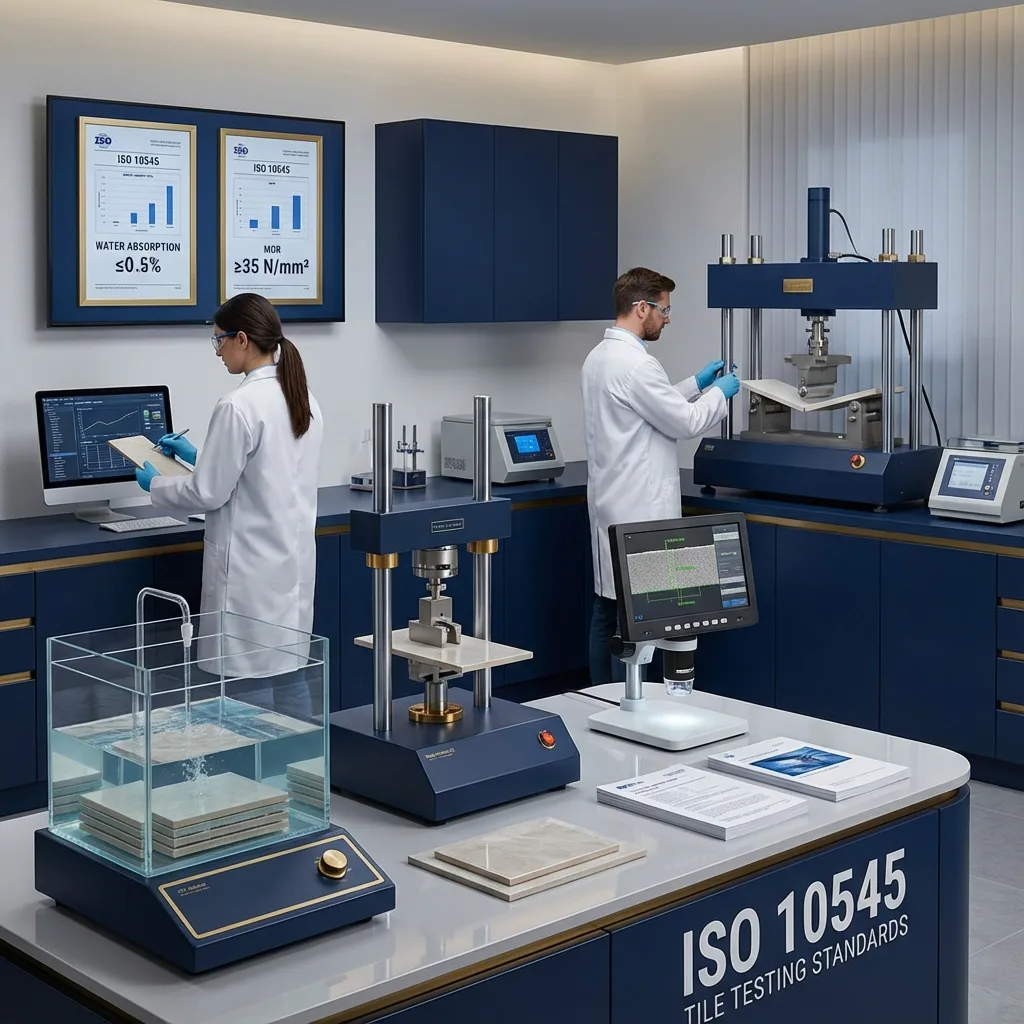
Introduction: Why ISO 10545 Standards Matter in B2B Tile Procurement
In international tile trade, a glossy catalog means nothing without verified technical compliance.
Large-scale buyers do not lose money because of color mismatch. They lose money due to technical failures, site rejections, and compliance disputes. That is why ISO 10545 is not a marketing reference. It is a contractual benchmark.
If you are sourcing porcelain tiles, ceramic wall tiles, or large-format slabs for residential developments, commercial projects, infrastructure or hospitality builds, then understanding water absorption, MOR, and breaking strength is non-negotiable.
This guide explains these parameters clearly, practically, and from a B2B export perspective, not a showroom sales angle.
What Is ISO 10545?
ISO 10545 is an international standard that defines test methods for ceramic tiles, including porcelain and ceramic bodies. It is not one test. It is a series of standards, each covering a different performance parameter.
Relevant sections for buyers:
- ISO 10545-3: Water Absorption
- ISO 10545-4: Modulus of Rupture and Breaking Strength
- ISO 10545-2, 5, 6, etc. for dimensional and surface properties
In export contracts, ISO 10545 compliance often forms the technical annex or is referenced during third-party inspection.
Understanding Water Absorption (ISO 10545-3)
What Is Water Absorption in Tiles?
Water absorption measures how much water a tile body absorbs, expressed as a percentage of its dry weight. This single metric determines durability, freeze-thaw resistance, suitability for wet areas, and classification as porcelain or ceramic.
ISO Classification Based on Water Absorption
| Tile Type | Water Absorption |
|---|---|
| Porcelain Tiles | ≤ 0.5% |
| High-quality Porcelain (export-grade) | ≤ 0.1% |
| Ceramic Wall Tiles | > 3% to ≤ 10% |
Critical point
If a supplier claims porcelain and the absorption is above 0.5%, they are either ignorant or lying. There is no third option.
Why Water Absorption Matters for Importers
Low water absorption directly impacts structural stability, resistance to staining, and long-term performance in bathrooms, kitchens, and outdoor areas.
For large-format porcelain slabs like 160x320 cm or 120x160 cm, low absorption is critical. High absorption in large slabs leads to micro-cracking during installation, which shows up months later.
Modulus of Rupture (MOR) Explained (ISO 10545-4)
What Is MOR?
Modulus of Rupture measures the flexural strength of a tile. In simple terms, it tells you how much bending stress a tile can withstand before breaking. MOR is measured in N/mm² (Newtons per square millimeter).
Typical MOR Values
| Tile Category | MOR Requirement |
|---|---|
| Porcelain Tiles | ≥ 35 N/mm² |
| Ceramic Wall Tiles | ≥ 15 N/mm² |
High-quality export porcelain slabs often exceed 40 N/mm².
Why MOR Is Critical in Real Projects
MOR matters more than thickness in many cases. Thin large-format slabs rely heavily on high MOR. Poor MOR leads to breakage during transport, handling, or installation. Low MOR is a red flag for weak pressing or poor raw material formulation.
Many suppliers hide behind thickness numbers. Experienced buyers look at MOR first.
Breaking Strength vs MOR: Do Not Confuse Them
This is where many sales teams embarrass themselves.
Breaking Strength Defined
Breaking strength measures the actual force required to break a tile, expressed in Newtons (N). It depends on tile thickness, size, and body density.
ISO Minimum Breaking Strength
| Tile Type | Minimum Breaking Strength |
|---|---|
| Porcelain Tiles | ≥ 1300 N |
| Ceramic Tiles | ≥ 600 N |
Large-format slabs typically exceed 2000–3000 N when manufactured correctly.
Key Difference Between MOR and Breaking Strength
MOR is a material property. Breaking strength is a product-dependent result. A thick tile with poor MOR can still meet breaking strength but fail in long-term performance. Serious buyers evaluate both.
Why ISO 10545 Compliance Is Critical in Bulk Export Trade
Risk Reduction in the Supply Chain
For FOB or CIF shipments, technical disputes are expensive. ISO 10545 test reports help avoid claim rejections, validate inspection results, and protect both buyer and exporter.
Required for Third-Party Inspection
Inspection agencies routinely verify water absorption, MOR, and breaking strength. If your supplier cannot provide lab-backed test reports, you should walk away.
Common Mistakes Buyers Make When Reviewing Tile Specs
Let's be blunt.
- Accepting catalog values without lab reports
- Ignoring batch variation
- Confusing EN standards with ISO without cross-checking
- Assuming all porcelain slabs are equal
If you are sourcing in bulk, especially from multiple factories, technical discipline is the difference between profit and loss.
How We Ensure ISO 10545 Compliance in Export Supply
As a B2B export trader, our role is not to sell stories. It is to control risk. Our sourcing process includes:
- Factory-level ISO 10545 test validation
- Batch-wise quality control
- Third-party inspection coordination
- Technical data sheets aligned with buyer standards
- Export documentation matching test parameters
Whether you are sourcing porcelain tiles, large-format slabs, ceramic wall tiles, or natural stones like granite, marble, limestone, and sandstone, technical transparency is built into the supply chain.
Conclusion: Technical Standards Decide Long-Term Success, Not Price
In international construction material trade, price is negotiable. Technical failure is not.
Understanding ISO 10545 standards for water absorption, MOR, and breaking strength allows buyers to evaluate suppliers objectively, reduce project risk, ensure long-term performance, and protect contractual interests.
If you are sourcing porcelain tiles, ceramic wall tiles, or natural stone for bulk import or large-scale projects, do not rely on marketing claims.
Contact our export desk for verified ISO 10545-compliant products, bulk FOB or CIF quotations, technical data sheets and inspection support, and long-term supply partnerships.