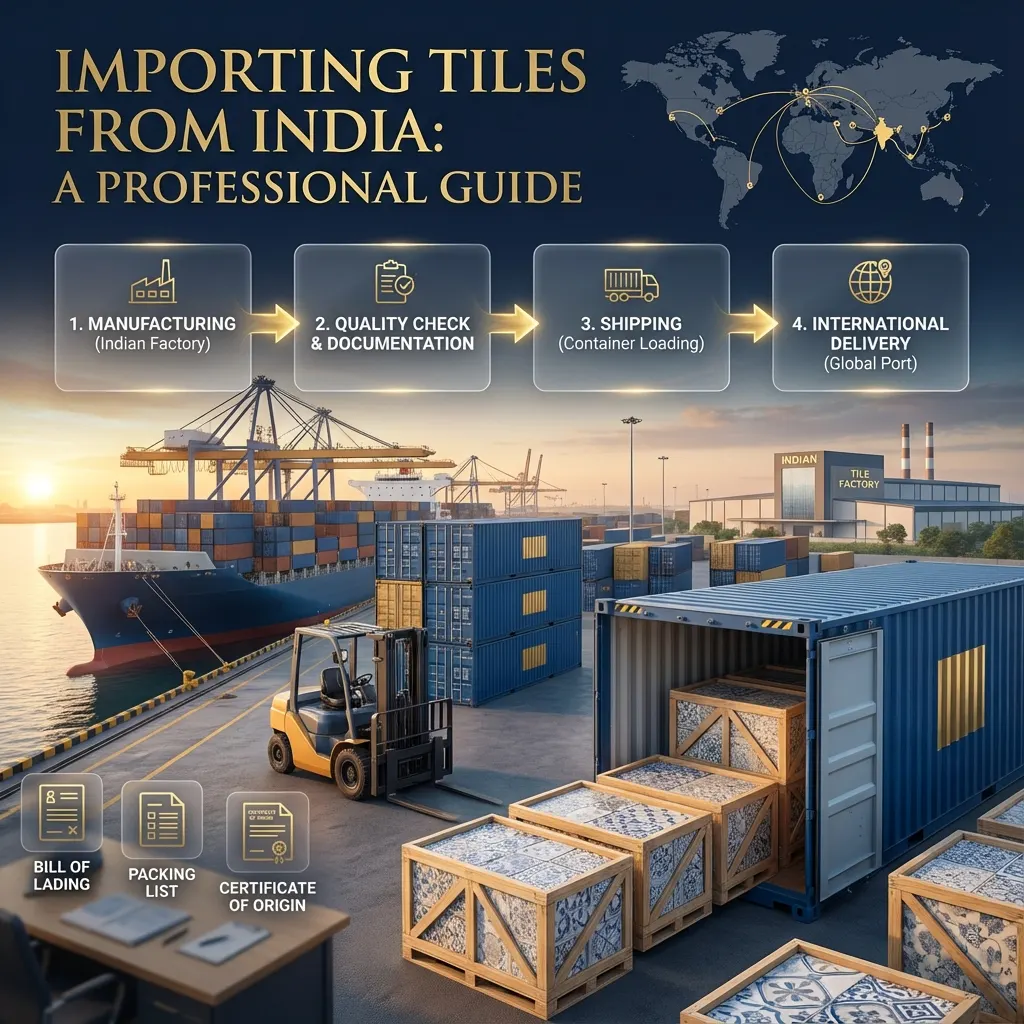
Introduction: Importing Tiles Is a Supply Chain Operation, Not a Purchase
Importing tiles from India is not about selecting designs and negotiating price per square meter. It is about factory capability validation, technical compliance, batch consistency, logistics planning, documentation accuracy, and risk management.
India is one of the world's largest exporters of porcelain tiles, ceramic wall tiles, and large-format slabs, but buyers who approach it casually often face delayed shipments, quality mismatches, breakage claims, customs issues, and cost overruns.
This guide explains how to import tiles from India step by step, specifically for B2B buyers, wholesalers, and developers sourcing in bulk.
Step 1: Define Your Technical and Commercial Requirements Clearly
Before contacting any exporter, you must lock these internally:
Product Specifications
- Tile type: porcelain floor tiles, large-format slabs, wall tiles
- Sizes: 60x120 cm, 80x160 cm, 120x120 cm, 160x320 cm, etc.
- Finish: polished, matte, carving, structured
- Thickness tolerance
- Edge details (rectified or non-rectified)
Performance Standards
- Water absorption
- Breaking strength
- Modulus of rupture
- Slip resistance (if applicable)
If you do not define these upfront, suppliers will define them for you. That never ends well.
Step 2: Identify the Right Indian Tile Supplier or Export Partner
India has manufacturers who only sell domestically, exporters who only trade price, and professional export suppliers who manage risk. Your job is to find the third category.
What to Evaluate
- Export experience and active markets
- Ability to supply consistent batches
- Range across porcelain, wall tiles, and slabs
- Understanding of FOB and CIF shipments
- Willingness to share test reports and packing details
Avoid suppliers who push catalogs before asking questions. That is a red flag.
Step 3: Sample Evaluation and Mock-Up Approval
Never skip this step.
What You Should Request
- Physical samples from the same production line
- Shade cards for batch comparison
- Surface finish samples
- Edge and thickness confirmation
What to Watch For
- Shade variation between pieces
- Warpage in large formats
- Finish uniformity
- Calibration accuracy
Digital images are useless at this stage. Real samples save real money.
Step 4: Finalize Pricing Structure: FOB vs CIF
This is where many buyers lose control of cost.
FOB (Free On Board)
- Supplier handles production and loading
- Buyer manages freight and insurance
- More control, more responsibility
CIF (Cost, Insurance, Freight)
- Supplier manages shipping to destination port
- Easier for first-time importers
- Slightly higher but predictable landed cost
Choose based on your logistics capability, not habit.
Step 5: Confirm Export Packing Standards
Tile damage is usually a packing failure, not a product failure.
Key Packing Elements
- Strong wooden or fumigated pallets
- Plastic strapping and corner protection
- Foam or cardboard separation for slabs
- Moisture protection for sea transit
For large-format porcelain slabs, improper packing guarantees breakage.
Step 6: Production, Batch Locking, and Quality Control
Once you confirm the order:
Critical Actions
- Lock batch and shade before production
- Confirm production timeline
- Define acceptable tolerance levels
- Decide inspection stage
Quality Control Options
- Factory self-inspection
- Buyer-appointed third-party inspection
- Random sampling during packing
Skipping inspection to save cost is one of the most expensive mistakes in tile imports.
Step 7: Export Documentation from India
Incorrect documents delay customs clearance and increase port charges.
Standard Export Documents
- Commercial invoice
- Packing list
- Bill of lading
- Certificate of origin
- Fumigation certificate (for pallets)
Additional Documents (Market-Specific)
- Test reports
- Compliance certificates
- Insurance documents
Documents must match the physical shipment exactly. Even small mismatches cause problems.
Step 8: Shipping, Transit, and Tracking
Tile shipments are heavy and sensitive to handling.
Key Considerations
- Container type: 20 ft vs 40 ft
- Weight optimization to avoid penalties
- Transit time planning
- Insurance coverage
Buyers often underestimate demurrage and detention costs. These eat margins fast.
Step 9: Destination Port Clearance and Local Logistics
Your responsibility does not end at arrival.
What You Need Ready
- Customs broker
- Import license (if applicable)
- Duty and tax calculation
- Warehouse or site delivery plan
Tiles sitting at port are not inventory. They are liabilities.
Step 10: Post-Arrival Inspection and Claims Management
Inspect immediately after unloading.
Check For
- Breakage percentage
- Shade consistency
- Packaging damage
- Quantity mismatch
If there is an issue, document it immediately. Late claims are usually rejected.
Common Mistakes International Buyers Make When Importing Tiles from India
Let's be direct.
- Selecting suppliers based only on price
- Ignoring batch consistency
- Underestimating packing importance
- Skipping third-party inspection
- Misunderstanding FOB vs CIF responsibilities
- Not planning for customs clearance
Most tile import failures are process failures, not product failures.
Why Many Buyers Choose an Export Trader Instead of Dealing with Factories Directly
Direct factory sourcing looks cheaper on paper. In reality: factories focus on production, not logistics; communication gaps increase risk; multi-product sourcing becomes complex.
An experienced export trader consolidates supply, manages quality across factories, coordinates logistics and documentation, and reduces operational load on the buyer.
That difference shows up after the first shipment.
Conclusion: A Structured Import Process Protects Your Margins
Importing tiles from India can be highly profitable or painfully expensive. The difference is process discipline.
A clear specification, the right export partner, proper packing, and controlled logistics turn India into a reliable supply base.
At Aleron Ceramic, we work with international importers, wholesalers, and developers to simplify the entire tile import process, from bulk porcelain tiles and large-format slabs to ceramic wall tiles, with full support on FOB and CIF shipments, quality control, and documentation.